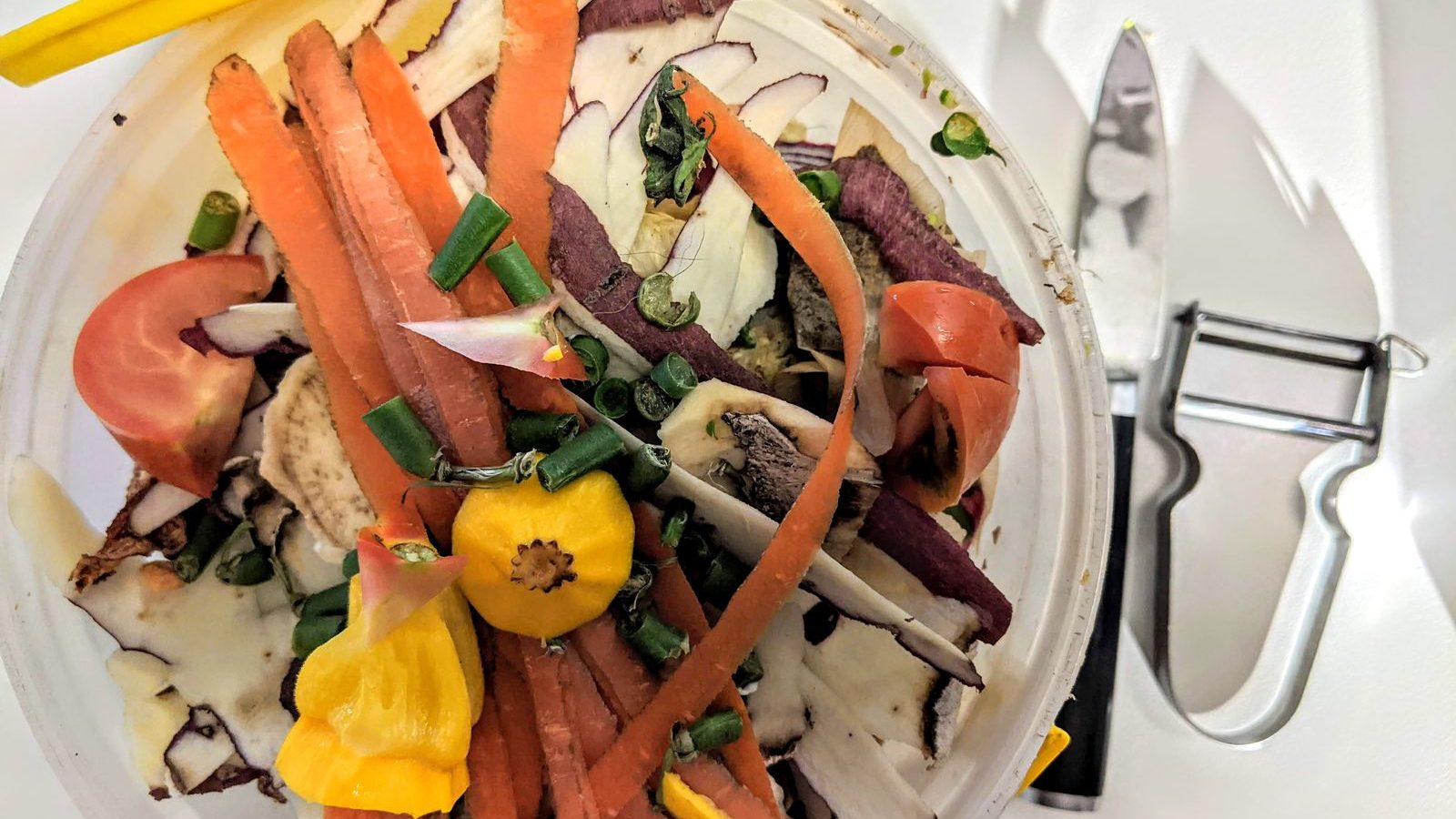
Imagine a bag with a leaf logo on it. The label says “compostable” in green letters. You drop it into your kitchen caddy with the carrot peelings and feel briefly virtuous. Twelve months later, on a council compost site, a worker fishes it out, still intact, and bins it as contamination.
This is not a rare scene. It is the default. The gap between what compostable plastic promises on the front of the pack and what it actually does in real life is, frankly, the most confusing piece of waste design in a modern kitchen. Let us untangle it.
Three different words, three different things
Most of the confusion comes from three terms used as if they meant the same thing. the EPA’s reducing-wasted-food-home page They do not.
- Biodegradable means the material will eventually break down through biological processes. It does not say how long, in what conditions, or into what. A biodegradable bag could take ten years and leave microplastics behind. Treat this label as basically meaningless.
- Compostable means it breaks down in a composting environment into something that can be returned to soil. ReFED’s overview of the US food-waste problem But there is a critical fork: industrial-compostable or home-compostable. These are not interchangeable.
- Home compostable means it can break down in a backyard compost heap at lower temperatures, usually within twelve months. This is the only label that gives you permission to put the item in your home compost.
The certification you can actually trust
Look for the small TUV Austria “OK compost HOME” logo or the European EN 13432 standard combined with a clear “home compostable” claim. If the pack just says “compostable” with no further detail, assume it means industrial-compostable, which requires temperatures of around 60 degrees Celsius and a managed facility. Your back garden does not reach that. Your council compost site might, but only sometimes.
What happens to compostable plastic in real life
Here is the awkward picture. If a compostable bag goes into:
Your home compost: unless it is certified home compostable, it will sit there for years, slowly fragmenting but not really decomposing.
Your food waste caddy for council collection: in many UK councils, compostable bags are now not accepted, because the in-vessel composting machines spit them out too early. The bags end up sorted into general waste anyway.
The general waste bin: which is mostly landfilled or incinerated, where compostable plastic behaves no better than regular plastic. In landfill it actually produces methane, which is worse than carbon dioxide for warming.
The plastic recycling bin: where it contaminates the stream and gets pulled out at the sorting plant.
Sobering, isn’t it. Compostable plastic is not, in most kitchens today, doing what its name implies.
So when does it actually help?
It is not all bad news. Compostable plastic does have honest, useful jobs.
Tea bags and coffee filters
Many tea brands have moved to fully compostable tea bag material, including the heat-sealed corners. These genuinely do break down in a home compost heap within six to twelve months. If you are not sure about your brand, check their website. If a tea bag has a slippery, plastic-feel mesh, it almost certainly contains polypropylene and should not be composted.
Caddy liners in cooperative councils
A handful of UK councils, especially in parts of Wales and certain London boroughs, have invested in composting facilities that genuinely process certified compostable bags. If you live in one of these, certified home-compostable caddy liners are an honest solution. Check your council’s website. If it does not explicitly say they accept compostable bags, assume they do not.
Specific catering and event contexts
Compostable cups and cutlery at a festival or large event, where everything is collected by a single waste contractor and sent to a single industrial composter, can work. In your normal kitchen, the same items basically cannot, because there is no chain from your bin to that kind of facility.
What to do instead
The honest, lower-cost route is usually:
- Use your council’s food waste caddy if you have one, with whatever lining method they approve. Newspaper is widely accepted and free.
- If you have outdoor space, run a real home compost bin for fruit and veg scraps. Coffee grounds, tea (loose or certified-compostable bags), and eggshells go in too. No meat or dairy.
- For the rest, focus on reducing food waste upstream so that the bin question matters less. The greenest bag is the one that does not need to exist.
The bin liner question, honestly answered
If you must use a kitchen caddy liner, a certified home-compostable one is still better than a regular plastic bag if your council accepts it. If your council does not, an unlined caddy washed weekly is actually the lowest-impact option. It sounds grim and is genuinely fine. The caddy lid keeps smells in. A quick rinse on a Tuesday evening is the whole job.
What the labels really mean, in one breath
If a pack says biodegradable, assume nothing. If it says compostable with no detail, assume industrial-compostable, which means you need a council that accepts it. If it says home compostable with a certification logo, trust it for your home heap. If it says nothing at all, treat it as standard plastic and recycle or bin accordingly.
None of this is anyone’s fault personally. The labels are vague on purpose because the supply chain for proper composting is uneven across the country. But once you know the difference, you can stop spending extra money on bags that do not, in your particular kitchen, do the thing they sold themselves on.
A small relief: the simplest answer, in most cases, is also the cheapest. Reduce what goes in, line with newspaper if you must, and save the certified compostable products for the few situations where they actually finish their job.
Frequently Asked Questions
Can I put compostable bags in my home compost heap?
Only if they are certified home compostable, usually marked with a TUV Austria OK Compost HOME logo. Other compostable plastics need industrial conditions your garden cannot provide.
Are compostable plastics better than regular plastic in landfill?
Not really. In landfill, they decompose anaerobically and release methane, which is a stronger greenhouse gas than carbon dioxide. The benefit only appears if they reach the right composting facility.
My council collects food waste. Should I use compostable liners?
Check your council's page. Many UK councils now refuse compostable liners because they do not break down fast enough in their processing systems. If in doubt, line the caddy with newspaper.
What is the difference between biodegradable and compostable?
Biodegradable just means a material will eventually break down at some point with no guarantee of when or into what. Compostable means it breaks down in a defined timeframe and leaves no harmful residue, but only in the right environment.
Do compostable tea bags actually compost at home?
Most modern certified-compostable tea bags do, within six to twelve months in an active home heap. Older or unlabelled bags often contain plastic mesh that will not break down. When in doubt, tip the leaves out and bin the bag.