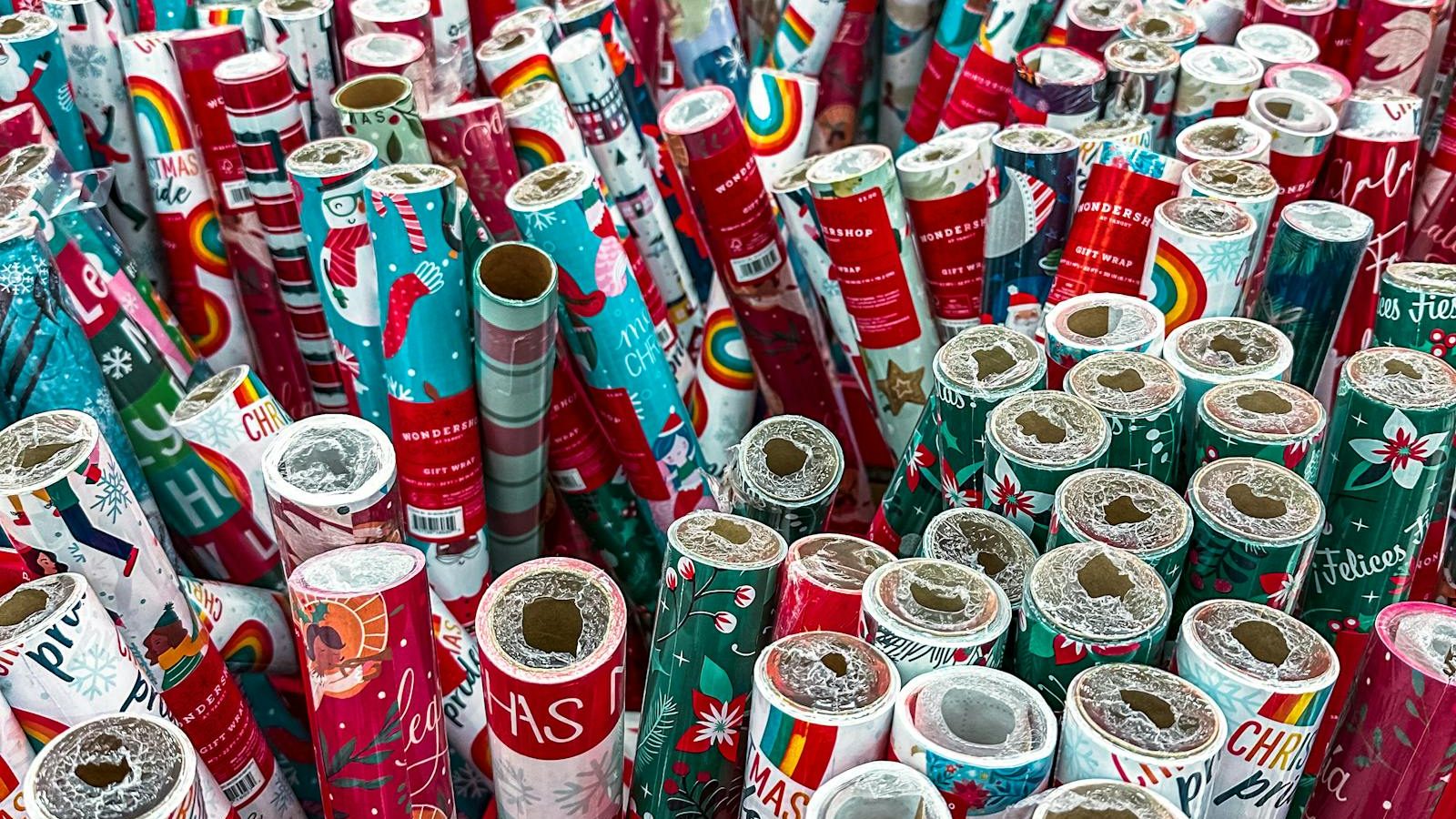
Christmas in most British households generates more waste in two weeks than the rest of December combined. The Royal Mail estimates the UK uses around 8,000 tonnes of wrapping paper at Christmas, much of which can’t be recycled because of the plastic coating, glitter, or foil. Add to that the crackers, the decorations, the packaging from gifts, the disposable plates and napkins, the spare food, the trees, and the cards. A typical UK family’s household waste roughly triples in late December.
None of this is a reason to cancel Christmas. It is, however, a reason to ask whether the bits that generate the most waste are also the bits that bring the most joy. ReFED’s consumer-education action area In most cases, they aren’t.
What follows isn’t a manifesto. It’s a set of small substitutions, mostly invisible, that make Christmas day quieter to clear up without it feeling diminished.
The wrapping paper question
Most commercial Christmas wrapping paper isn’t recyclable. The shiny stuff, the glittery stuff, the foil-coated stuff, these go in landfill. Only plain, uncoated paper that passes the “scrunch test” (it stays scrunched when you ball it up) can be recycled with regular paper waste.
The simplest swap is to use plain brown craft paper. A 25m roll costs around £5-£8 and wraps a household’s entire Christmas. It’s recyclable, composts, and looks elegant with a length of string or twine and a sprig of rosemary, dried orange slice, or sprig of holly tucked under the bow. People who see Pinterest-style brown-paper packages assume effort. The actual effort is wrapping with paper and tying with string.
The fabric option, properly
Furoshiki, the Japanese tradition of wrapping gifts in fabric squares, has been adopted patchily in the UK and US over the last decade. The fabric becomes part of the gift, or gets used again next year. A drawer of six or eight cloth wraps in different sizes lasts a family for years.
You don’t need to buy fabric specifically for this. Old scarves, tea towels, fabric scraps, or charity-shop fabric squares all work. The bigger the fabric square, the bigger the gift you can wrap.
The first year there’s a small learning curve, a YouTube video on basic furoshiki ties helps. From the second year on, it’s faster than tape and scissors.
The card question
Roughly 1 billion Christmas cards are sent in the UK each year. Most are read, displayed for a few days, and recycled. Many have glitter, foil or plastic coatings that prevent recycling.
Three approaches that reduce the impact without removing the gesture:
- Send fewer cards, only to people you don’t see often. The neighbour you see weekly doesn’t need a card; they need a knock on the door with a mince pie.
- Choose plain, recyclable cards (avoid glitter and foil).
- Send e-cards or longer messages to close friends and family who would prefer the words to the object.
None of these reduces affection. They just reduce the volume of glittery cardboard that needs sorting on 2 January.
Crackers, honestly
Most Christmas crackers contain plastic. The toy inside, the wrapper, the foil, the strip that goes bang, these are not recyclable as a unit. Eight crackers across a Christmas table generate roughly the same waste as a fortnight’s general household plastic.
Options, in order of effort:
- Buy “fillable” crackers from a craft shop, fill them yourself with small wooden toys, chocolates, or handwritten jokes. The shell is reusable for years.
- Buy crackers from one of the few brands that genuinely make plastic-free versions, Keep This Cracker, Cracker Co. and a few department-store ranges.
- Skip the cracker. Replace it with a small handwritten message at each place setting, with the joke or wish inside.
The cracker tradition is partly the bang and partly the silly hat. Whether you keep those things depends on your household. The plastic trinket inside, in my experience, is the bit nobody actually remembers six hours later.
The tree
The plastic-vs-real-tree debate is more nuanced than people think. A real tree grown locally, used once, composted afterwards, has a relatively low carbon footprint and supports forestry. An artificial tree made in China typically takes around 10-12 years of use to break even with the real tree on carbon, longer if the real tree is replaced annually with a local one.
The honest options:
- A real tree from a local Christmas tree farm, replanted or composted afterwards.
- A potted tree you keep in the garden the rest of the year and bring indoors briefly.
- An artificial tree, if you have one, used for at least 12 years before replacing.
- A branch arrangement, dried foliage display, or wooden tree alternative for those who don’t want a tree at all.
None of these is the “right” answer. The right answer is the one you’ll keep doing for years rather than swapping each Christmas.
Decorations: the slow build
The cheapest, most wasteful Christmas decorations are the £3 packs of tinsel, baubles and plastic stars that supermarkets stock in November. They look fine for one season and break by January.
The decorations that last and look better over time are usually:
- Wooden ornaments, pass through generations, can be repainted.
- Glass baubles, treated carefully, last decades.
- Dried materials, orange slices, cinnamon sticks, pine cones, eucalyptus.
- Handmade decorations, felt, paper, salt dough, made over the years and accumulated.
- Lights with replaceable bulbs, used for years rather than thrown when one bulb fails.
The slow-built decoration collection has a quality that the supermarket-pack version doesn’t. The ornaments have stories. The salt-dough star a five-year-old made survives long enough to come out at her thirtieth Christmas. The collection grows rather than getting replaced.
The food side
Christmas food waste is significant, the UK throws away around 270,000 tonnes of food at Christmas. Plan portions realistically, have a Boxing Day plan for leftovers, freeze what you can’t eat in the first three days, and use cloth napkins instead of glittery paper.
Gifts: less, better
This is the bit nobody wants to write about because it touches the heart of Christmas for most people. But the truth is that gift-giving has expanded over the past few decades in ways most people privately admit are excessive. The Secret Santa among siblings, the agreement among adult cousins to skip presents, the £20-cap-per-person rule, these are increasingly common because they’re kinder than the alternative.
Approaches that families are increasingly adopting:
- One main gift per adult, often something experiential.
- Stockings for children only.
- Handmade or homemade gifts among adults, jams, baked goods, photo prints, written letters.
- “Charity instead” arrangements, donate to a chosen cause in someone’s name.
None of this is austere. It’s a recalibration of where the energy of Christmas goes, towards food, people, time, music, the long walk on Boxing Day, the small rituals, and away from the volume of unwrapping.
The quiet endpoint
A Christmas without plastic wrap doesn’t look different from across the room. The tree is still there. The food is still on the table. The people are still there. What’s different is what’s in the bin on Boxing Day morning, fewer bags, less glitter, a small pile of brown paper and fabric squares instead of the usual heap.
Nobody, in my experience, has ever come downstairs on Boxing Day and complained that the bins look too tidy. The version of Christmas that generates less waste is, in most households, also the version that feels calmer the next morning. That’s a reasonable trade.
Frequently Asked Questions
Is brown paper recyclable after Christmas?
Yes, plain brown craft paper without coatings recycles with normal paper waste. It also composts and burns cleanly. Check it passes the "scrunch test" — if it stays scrunched, it's recyclable.
What can I use instead of plastic wrapping paper?
Brown craft paper with string and a natural decoration, fabric wraps (furoshiki style), old newspapers or maps for an interesting look, or reused gift bags from previous years.
Are plastic-free crackers any good?
Yes, several brands now make crackers with paper hats, wooden toys and biodegradable bang strips. They're slightly more expensive but compostable, and the gift inside is usually better than the plastic novelty.
Is a real Christmas tree better than an artificial one?
Usually, if it's locally grown and composted or replanted after use. An artificial tree needs 10-12 years of use to break even with real trees on carbon footprint.
How can I get family members on board with less waste at Christmas?
Suggest rather than prohibit. Propose a "homemade gifts only" agreement among adults, a Secret Santa among siblings, or an experience-instead-of-gifts year. Many family members are quietly relieved when someone suggests less.
What's the biggest source of Christmas waste?
Wrapping paper (especially the foiled and glittered kinds) and food waste are the two largest categories. Reducing those two alone cuts most household Christmas waste significantly.