“I just keep forgetting.” This is the sentence I have heard more than any other about reusable bags. It comes with a small shrug, often a slightly embarrassed laugh, and the implication that the person saying it has some kind of memory failing the rest of us do not. They do not. Their bags are simply in the wrong place.
Forgetting reusable bags is almost never a memory problem. It is a placement problem. Once you treat it as placement, the whole thing solves itself within about a fortnight, and then stays solved for years.
Why the cupboard under the stairs is a graveyard
The single most common location for reusable bags in the homes I have visited is the cupboard under the stairs, or some equivalent storage spot. NIH research on lasting habits This is a reasonable choice for “things we own”. It is a terrible choice for “things we need to grab on the way out of the door”.
The problem is that the cupboard is not on the way out. You do not walk past it. You do not see it. You would have to remember the bags, then go out of your way to fetch them, then put them somewhere you would not forget them again. By the time you have done all of that, you are running late, and the brain has filed the trip under “well, we are leaving now anyway”.
Where bags should actually live
The right place for reusable bags is on or near the path you take when leaving the house. Not in a cupboard near that path. On the path. Where your elbow would brush them. Where your eye lands without effort. That is where bags stop being forgotten and start being used.
The exact location depends on your house, but the principle is the same. Find the route you take from the kitchen or living room to the front door. Identify the spot where every adult in the house pauses, even briefly. That spot is the bag spot.
The three-zone bag system
The system I use has three zones, and roughly fifteen bags in total spread across them.
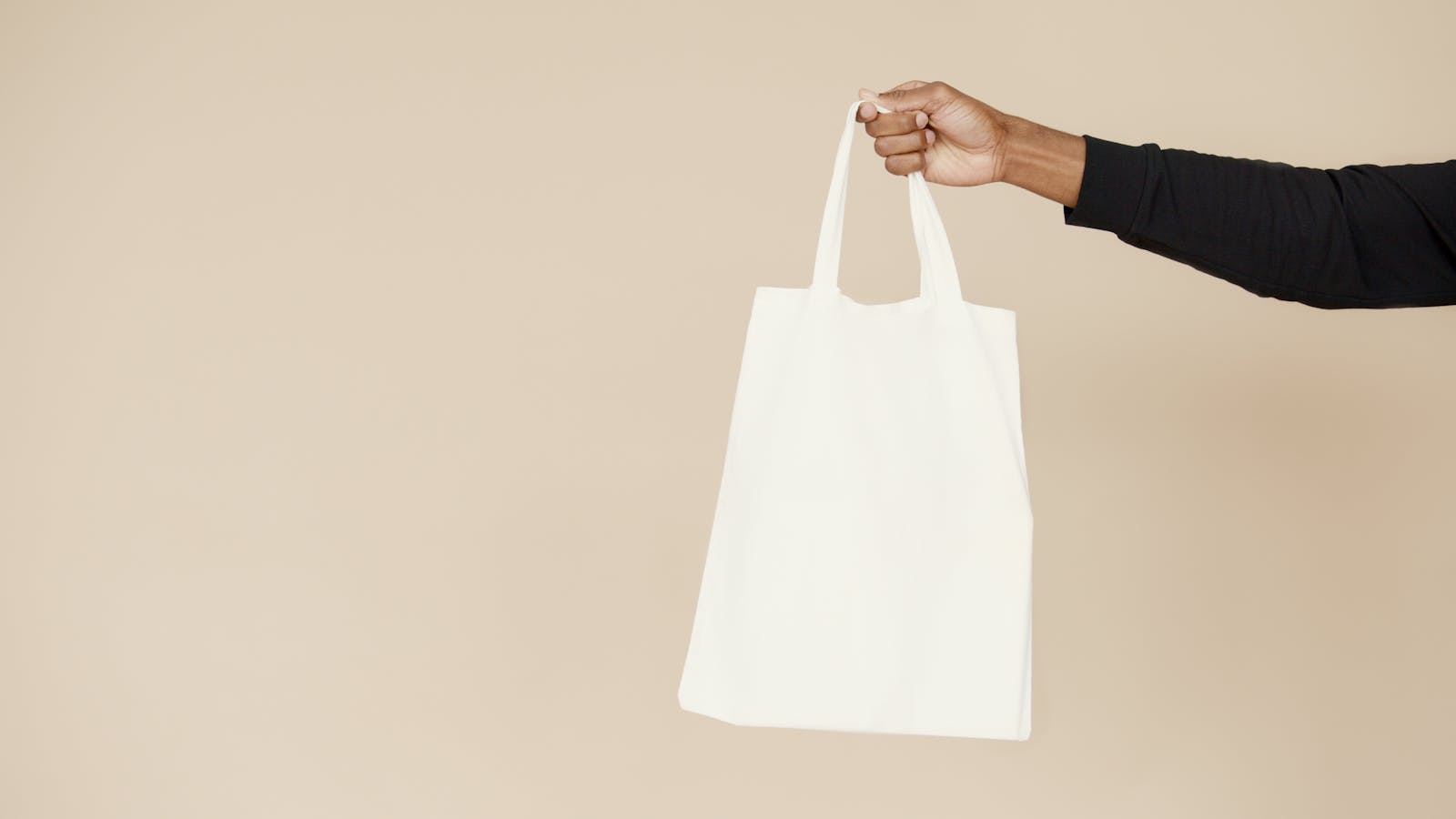
- The hallway hook, near the front door, with three to four folded fabric bags
- The car door pocket, with two folded bags for unplanned shops
- The coat pocket in each regularly used coat, with one folded bag
The hallway is the main rotation. The car covers driving trips. The coat pockets handle the times you have somehow forgotten the other two, which still happens occasionally and is the reason for the redundancy.
None of these locations require any memory. The bags are simply there. The act of leaving the house puts you in physical proximity to a bag, with no effort on your part. That is the whole trick.
The folding ritual
The other thing that helps enormously is a consistent fold. Most people stuff reusable bags back into their slot in whatever shape they were in at the shop. This leads to bags taking up too much space, looking untidy, and gradually being moved to make room for other things. Once they migrate, they get forgotten.
I fold mine into roughly the size of a small paperback book. It takes about fifteen seconds per bag. The bag stays folded between uses. The hook holds four or five bags in a neat stack rather than a chaotic pile. The visual order is part of why the system survives the rest of the family’s less tidy habits.
The technology trap
Several people I have spoken to have tried reminder apps or phone alarms for reusable bags. These almost never work, for two reasons.
First, the reminder usually fires at the wrong time. You are not on your way out of the house when the alarm goes off. You are in the middle of something else, you note the reminder, you forget it again by the time you actually leave. Second, the reminder treats the issue as a memory problem rather than a placement problem. Solving placement does not require a phone.
The exception is a small phone-based note or shopping list app that includes “bag” as a line item. This is less about reminding and more about pattern reinforcement. Seeing “bag” at the top of your shopping list every time you shop is a quiet weekly nudge that the bag matters enough to be on the list.
Building backup into the system
Even with a well-placed bag system, you will occasionally find yourself at a shop without one. The fix is a lightweight foldable bag that lives permanently in one of your coats. These fold down to roughly the size of a wallet and weigh next to nothing. Slipping one into the inside pocket of your two most-worn coats means you are essentially never without a bag, and the “I have nothing” moment quietly disappears.
One reader’s set-up
A reader named Aisha wrote about her bag system. “I have a hook by the door for fabric bags, two foldable bags in my work coat, one in the kitchen drawer where I keep the keys, and two in the car. I genuinely never forget bags. Not because I am organised but because I have backups in three places where I might pass by.” That layered approach is overkill on paper and exactly right in practice.
What to do with the bags after a shop
The other half of the system is what happens after the shopping. If the bags do not return to their proper spots immediately after unpacking, the whole thing falls apart within a few weeks. Bags accumulate on chairs, kitchen counters, the bottom of stairs. Eventually somebody puts them all in the cupboard under the stairs to tidy up, and you are back to square one.
The rule, which is the entire system in one sentence: bags are returned to their hooks or pockets before the kettle is put on. Not after. Before. The kettle is the reward, and the reward only happens once the bags are back in place. It sounds petty but it works, because it makes the return a habit rather than an afterthought.
What about supermarket bag fees
Many people only started reusing bags after charges were introduced for single-use ones. The charges did not create the willingness to reuse bags. They simply gave people the small nudge needed to design the placement system in the first place. Even if the charges were removed tomorrow, a well-designed bag system would keep running. The engine is the placement.
The compound effect
A reusable bag system, once it is genuinely working, removes one of the most common micro-frustrations of daily life. You stop worrying about whether you will have a bag. You stop juggling armfuls of groceries from the boot to the door. You stop the small guilty paper-bag purchases at every shop that does not stock plastic anymore.
More importantly, you stop being the person who keeps forgetting. You become the person who never forgets, not through effort but through design. That small identity shift, from “I am forgetful about bags” to “I just have a system”, carries over quietly into other parts of low-waste living. The bags are a starting point. Once you have built one location-based habit successfully, the rest of them get easier.
And the cupboard under the stairs can go back to holding the vacuum.
Frequently Asked Questions
How many reusable bags do I really need?
Around six to eight covers most households. Three to four on the hallway hook, two in the car, one or two in coat pockets. More than that tends to mean some never get used.
What kind of reusable bag is best?
A mix is useful. Strong cotton or jute for big shops, lightweight foldable ones for coat pockets, mesh produce bags for fruit and veg. Avoid heavy fancy bags you would not want to fold up small.
Should I wash my reusable bags?
Yes, every month or so, especially for ones used for fruit, veg or anything that leaks. Most fabric bags can go in with a regular laundry load. Mesh produce bags wash easily and air dry quickly.
What if my partner keeps moving the bags elsewhere?
Quietly put them back. Most people are following the path of least resistance. If the hook is the easiest spot, the bags will end up there within a fortnight without any conversation needed.
Do supermarket bag charges actually help reduce waste?
They created the initial nudge for many people. The lasting behaviour change comes from the system you set up at home in response. The charge gets the habit started, the placement keeps it going.