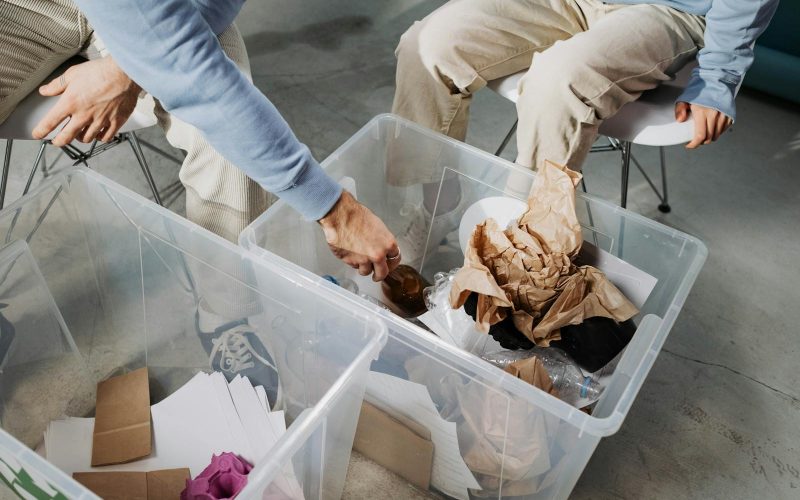

Maya rents a studio in Hackney. The kitchen is two metres wide. She’d been told for years that good recycling required a row of separate bins, one each for paper, plastic, metal, glass, and food waste. Five bins. Nine square feet of bin. In her kitchen, the math didn’t work. So she did what most flat-dwellers do, which is to give up on sorting at home and hope the council would manage. Half her recycling ended up in the wrong place.
The good news is that you don’t need five bins. You don’t even need three, in most cases. A small-apartment recycling setup can fit under a sink, behind a cupboard door, or stacked vertically in a corner. What you need is a plan that suits the space and the local rules, not a magazine photo of bespoke pull-out drawers.
Start with what your council collects
Most UK councils now run one of two systems. Recycle Now’s how-to guide (UK) Either everything is co-mingled into a single recycling bin, paper, card, plastic, metal all mixed together, or there’s a partial split, typically paper and card in one container and plastic, metal, and glass in another. Some still collect glass separately. Food waste is increasingly its own caddy.
The number of separate streams you need at home depends entirely on this. If you live in a co-mingle area, you need exactly one indoor recycling container plus a food caddy. That’s it. If you live in a split area, you need two indoor recycling containers plus a food caddy. The five-bin model is a museum piece for most flats.
The under-sink solution
For a single-stream area, a 20-litre swing-lid bin under the sink works well. It takes up almost no extra floor space, hides the contents, and can be lifted out when full. Pair it with the food waste caddy that the council supplies, usually a small green or brown box that fits on a worktop or just inside the cupboard.
For a split-stream area, two narrower bins side-by-side under the sink can work if the cupboard is wide enough. Otherwise, consider a tall pedal bin in a corner with an internal divider, or a stackable tower.
Stacking, vertically
If horizontal space is the constraint, go up. Stackable boxes from B&Q or Wilko cost about a fiver each. Three of them stacked make a column 60 centimetres tall and 30 across, easy to slot into a gap between fridge and wall. Label each level: paper on top because it’s lightest, plastic in the middle, metal and glass at the bottom because they don’t mind being squashed.
The crucial rinse step
Small spaces and unwashed packaging do not mix. A yogurt pot left unrinsed in a sealed cupboard for three days will let you know about it. A single sweep of cold water as you scrape into the food caddy is enough, you’re not sterilising, just removing the major residue. This is the single most important habit for indoor recycling in a flat. Skip it and the cupboard turns into a science experiment.
Squashing matters more than you think
Flats fill bins quickly because most household packaging is mostly air. A milk bottle without squashing takes the same space as the milk did. A cereal box flat takes a quarter of the space of one stood up. A few seconds of crushing means you might empty the bin every five days instead of every three.
- Squash plastic bottles vertically and screw the cap back on to trap the compression
- Tear cardboard boxes flat along their existing creases, don’t bother breaking down small ones
- Crush aluminium cans either by hand or with a foot
- Stack flat items together rather than letting them drift to the bottom
What to do about glass
If your council collects glass at the kerb, it goes in your single recycling stream. If not, you’ll need to take it to a bottle bank. The right home for empties in a flat is a small paper bag or a tall reusable tote kept next to the bin. When the bag fills up, usually every couple of weeks, it’s a quick walk to the corner bottle bank. Don’t store glass in volume inside the flat; it’s heavy and noisy.
Food waste, the make-or-break
The single biggest source of indoor recycling smell is food waste, not packaging. Get this right and the rest of the system stays manageable. UK councils that collect food waste provide a small kitchen caddy with compostable liner bags. Use them. Empty into the outdoor caddy at least twice a week, more often in summer. The smell barrier is a daily emptying habit, not a fancy bin.
If you don’t have a food collection, freezing scraps in a labelled bag and binning them just before pickup day is a workable alternative for general waste.
What about flat-share politics
Diane in Glasgow wrote in describing her sixth flatshare, where bin habits had collapsed because no one wanted to take responsibility for the cupboard. Her fix: a single A4 laminated sheet stuck to the inside of the recycling cupboard door, with a list of what goes where, written in a Sharpie. Disputes dropped to zero within a week. The trick wasn’t enforcement; it was removing ambiguity. People will do the right thing if they know what the right thing is.
The bag system for collection day
If your block of flats uses communal bins, transporting your sorted waste downstairs is the final friction point. A cheap canvas tote, or even an old supermarket bag-for-life, makes the trip easy. Some flats keep two, one in transit, one filling up. The tote dedicated to recycling never holds general waste, so it doesn’t need cleaning.
A note on minimalism
The smallest recycling station I’ve ever seen was in a Tokyo apartment a friend rented years ago, two small plastic boxes, side by side, no lids, slid against the wall behind the kitchen door. Everything got rinsed and binned the moment it was finished with. The whole system occupied less space than a microwave. It worked because the habit was tight. Space isn’t really the constraint; it’s the discipline of dealing with things as they happen instead of letting them pile up.
A flat doesn’t need to look like a household waste centre to recycle properly. It needs one bin, one caddy, a quick rinse, and a habit of squashing as you go. The rest is just rearranging.
Frequently Asked Questions
Do I really need separate bins for different materials?
Only if your council asks for it. Most UK councils now use a co-mingled system, meaning all recyclables go in one bin. Check your local rules before buying anything.
How do I stop my recycling cupboard smelling?
Rinse everything before binning. The smell almost always comes from leftover food residue, not the packaging itself. A few seconds with a spray bottle is enough.
Where can I store glass in a small flat?
In a small tote bag near the bin, emptied to the bottle bank every two weeks. Don't keep glass in volume — it's heavy and clinks loudly when moved.
How often should I empty an indoor food caddy?
At least twice a week in winter, daily in summer. The compostable liner can't hold odours forever, and a stale caddy will spread its smell to the rest of the kitchen.
What's the best bin shape for a tiny kitchen?
Tall and narrow, ideally with a lid. Pedal bins fit corners well. If under-sink, swing-lid models are easiest to use one-handed.
How do I share a recycling system with flatmates?
A laminated sign on the cupboard door listing what goes where ends most disputes. Ambiguity is the enemy, not laziness.