“I have decided,” my neighbour said over the garden fence, “that we have enough mugs.” This was a Sunday in October. By Christmas, she had received four new mugs as presents, two for being the world’s best mum and two from a school fair. Her cupboard now holds twenty-three mugs for a household of three.
This is the precise moment where the “one in, one out” rule earns its keep. It is not a dramatic decluttering method. It is not a minimalism manifesto. It is a tiny, almost domestic rule of thumb that catches the slow accumulation that turns even careful homes into stuffed ones. Used loosely, it does most of the work of any tidying system you have ever heard of.
What the rule actually means
The basic version is this. For every new item that comes into the house, one similar item leaves. A new jumper means an old jumper goes to a charity shop. A new frying pan means the warped old one heads off to be recycled. A new mug means a chipped mug is quietly retired.
The point is not to keep a strict count. The point is to break the assumption that “in” is the only direction stuff can travel. Most homes have no equivalent of an out-tray. New things arrive. Old things stay. The drawers get fuller. Then we buy storage boxes to manage the fullness, and the storage boxes become their own problem.
Why it cuts waste, not just clutter
The waste angle is the part most people miss. James Clear’s three-R model for habit change When you start asking “what goes out for this to come in”, you find yourself buying less in the first place. The mental cost of “do I have anything that needs to leave” turns out to be just high enough to interrupt the small, half-thought purchases that fill our homes.
A reader called Tom emailed me about exactly this. “I thought one in, one out would mostly stop my house being cluttered. It mostly stopped me buying things I did not need.” That is the quiet trick. The rule is sold as a tidying tool. In practice, it works upstream, at the point of purchase.
Where the rule starts to wobble
There are categories where strict one in, one out makes no sense. Children’s clothes are the obvious one. A growing child does not “swap” trousers, they outgrow them. Books, for many people, are also a special case. Food and consumables are not really part of this rule either, because they are designed to leave.
I do not pretend my own version is consistent. I am quite strict on mugs, kitchen gadgets, t-shirts and trainers. I am less strict on books, art supplies and the children’s drawer that lives by the front door and seems to refill itself by witchcraft.
How to start without it feeling like a project
The most common mistake is to start by trying to declutter first. Do not. Start with the next thing that arrives. Whatever it is. A new shirt, a new pan, a free pen from the bank. As you put it away, ask what is leaving. If nothing is leaving, ask whether the new thing actually needed to come in.
Repeat for a fortnight. You will be surprised how quickly the rule starts to do its work without any heroic clear-out. Most homes have a quiet circulation rate of new items per week, and applying the rule even slightly catches most of it.
- Clothes: one new item, one item to charity or recycling
- Mugs and glasses: one new, one chipped or unused
- Kitchen tools: one new, one duplicate retired
- Toys: one new, one to a friend or a charity shop
- Pens, notebooks and stationery: one new, one used up or passed on
The “out” side is the bit that matters
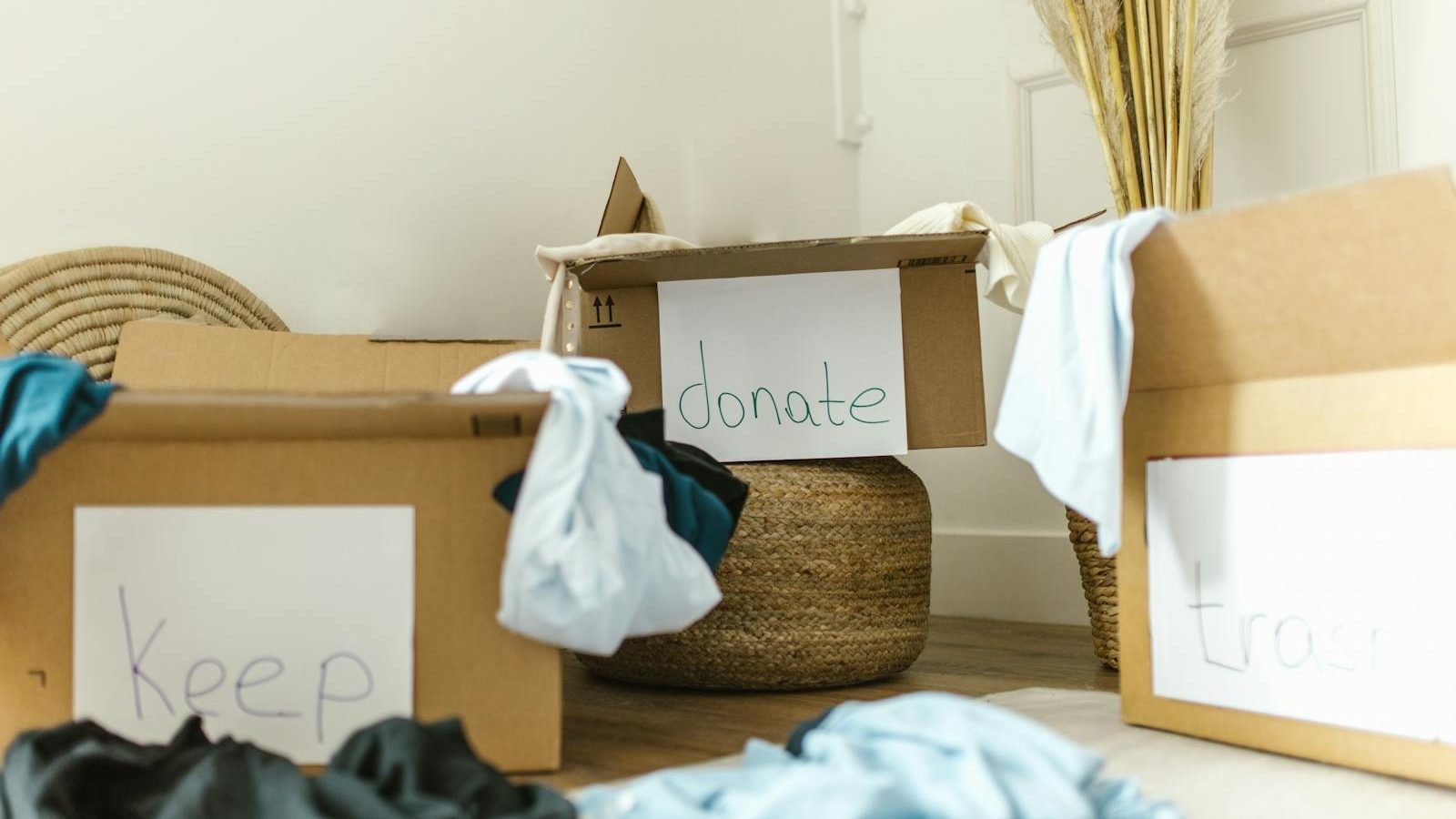
Most waste-reduction effort goes into the “in” side, which is fair, because what we buy is the largest single lever we have. But the “out” side is where the rule earns its specifically anti-waste credentials. If the old jumper goes in the bin, you have just moved the problem. If it goes to a charity shop, a textile recycling bin or a friend who will wear it, you have actually closed the loop.
Set yourself one fixed “out” route per category. Mine looks like this. Clothes go in a paper bag in the bottom of the hall cupboard, and when the bag is full, it goes to the textile recycling at the supermarket. Books go on the top shelf of the bookshelf nearest the door, and when there are six of them, they go to the charity shop on the corner. Electronics live in a labelled basket in the spare room.
Why it works for real homes, not show homes
The reason one in, one out beats most decluttering methods in practice is that it does not require a free weekend, a system or a personality change. It runs alongside normal life. It does not ask you to imagine a future tidy home. It only asks you to make one small decision when a new item arrives.
Show homes use methods that require a single dramatic intervention. Real homes need a method that survives the everyday entropy of children’s drawings, broken biros, kind-but-misjudged presents and the small things that slip in through the door every week. One in, one out is essentially a quiet maintenance tool, and maintenance is what real homes need.
The rule in busier seasons
December is the test. Christmas brings a wave of “in” that no rule can entirely keep pace with. The way I handle this is to give myself a small grace period and then run a January version of the rule, where every gift that came in gets a long-considered look. Some are wonderful and stay. Some are kind but not useful and are passed on by mid-January, while they are still in good condition and easy to rehome.
The same applies to birthdays, school terms ending, house moves and other surges. The rule is not broken by these moments. It just absorbs them with a slight delay.
What changes after a year
If you run the rule lightly for a year, two things happen. The first is that your home stops growing. Not gets smaller. Stops growing. That alone is significant, because the steady accumulation of stuff is the main driver of clutter and a hidden driver of waste, since stuff that piles up tends to get forgotten, damaged or thrown away unused.
The second thing is harder to describe. You become noticeably more deliberate when buying. The question “what would have to go” sits quietly in the back of your mind in shops, online, at markets. Small purchases that would once have been automatic now have a tiny pause built in. The pause does most of the work.
The mug situation, by the way, is now sorted. My neighbour put six older mugs in a box on her doorstep with a sign saying free, and they were gone by lunchtime. The cupboard now holds seventeen mugs, which is still too many, but it is going in the right direction. The rule does not deliver miracles. It just stops the slow drift in the wrong one.
Frequently Asked Questions
Do I have to declutter first before starting the rule?
No, and it is usually better not to. Start with the next item that comes into your home. The rule works steadily over time without needing a dramatic clear-out to begin with.
What counts as "out"?
Anything that leaves the house and is not bound for landfill if you can help it. Charity shops, textile recycling, friends, hand-me-down boxes, online listings and proper recycling all count.
Should I apply the rule to books?
Up to you. Many people are happy to make books an exception. If your shelves are buckling, apply a softer version, perhaps one in, one out every two or three books.
How do I handle gifts?
Give a present a fair chance, usually a few weeks of trying it. If it is genuinely useful, keep it. If it is not, pass it on while it is still in good condition. The giver wanted you to be happy, not to manage their item.
What if my partner does not want to play along?
Apply the rule only to your own things. Most people find that watching one person quietly run the rule for a few months is more persuasive than any conversation. The household drifts towards the lighter pattern naturally.
Does the rule work for digital clutter too?
Loosely, yes. The same logic applies to apps, subscriptions and email lists. Add one, drop one. It is less rigorous than the physical version but the principle is the same.