“But I live in a flat” is the most common reason people give for not composting, and almost every time it turns out to be inaccurate. They don’t live in a flat in the middle of nowhere. They live in a flat in a city or town that almost certainly has at least three places that would happily take their food scraps, and they have just never thought to ask.
The point of composting is not the heap. The point is that the scraps don’t end up in landfill, where they produce methane in airless conditions. The heap is one solution among several. Below are eight others, in roughly the order of how widely available they are.
1. Council food waste collection
In the UK, most councils now offer separate weekly food waste collection. You get a small countertop caddy for the kitchen and a larger outdoor bin (or a communal bin in flats), and you put cooked food, plate scrapings, peelings, bones, the lot, into it. The contents go to industrial anaerobic digestion plants or in-vessel composters, where they become a mix of biogas (used to generate electricity) and digestate (used as agricultural fertiliser).
It is the least romantic option. It is also, for most people in flats, the most useful. The collection is free, the bin is tiny, and you don’t have to think about microbes. Check your council website, many people have these services available and don’t realise it. USDA composting overview In Scotland, separate food waste collection is now the default for most local authorities.
The one limitation: a small minority of councils still don’t collect food waste, particularly in some rural areas. If you’re in one of these, scroll down.
2. Community composting schemes
Community composting points are increasingly common in cities. They are usually run by a local council, a community group, or a transition town network, and they consist of a few large bins at a publicly accessible location, a community garden, the edge of a park, a community centre car park. You bring your food scraps, you tip them in, you leave. Volunteers turn the heaps.
To find one, search your town name with “community composting” or “community garden compost”. Locations include the Camden Garden Centre points in north London, the GoodGym-run schemes in some boroughs, and a growing number of community gardens that explicitly invite drop-offs. There are now well over a thousand in the UK.
3. Garden Share and ShareWaste
Both are online platforms (the second is an app) that connect people who have compost heaps with people who have scraps. You sign up, see a map of nearby “hosts” who will accept food waste, and arrange to drop off, often weekly. It is the friendliest of the options. You usually end up knowing your host, swapping the occasional jar of homemade chutney, and getting to peek at someone’s garden.
The map is patchier than the council scheme but in many cities it covers more area than you would expect. If there isn’t a host near you, you can become one if you eventually move somewhere with space.
4. Allotment plots
Allotments have compost heaps. Many have communal compost areas. If you don’t have a plot, you may still be able to drop off scraps if you know somebody who does, or by asking the allotment secretary if there is a community heap. Some sites explicitly welcome it, the food scraps speed up otherwise sluggish heaps.
This is also a route into having a plot yourself, eventually. Some allotment associations run “produce in exchange for scraps” arrangements where you help with the communal heap and take home vegetables.
5. Workplace composting
If your workplace has a tea room, a canteen, or any kind of staff kitchen, it almost certainly produces enough scraps to justify a small composting setup, a council collection (most commercial premises have to organise their own), a wormery, or a partnership with a local community garden.
If your office doesn’t already have one, this is the polite-but-persistent role. Quote the methane numbers, propose a small-scale system, ask about food waste services. The actual installation often costs the workplace nothing and saves them money on general waste collection.
6. Bury it in a planter or window box
A surprisingly under-used option. A large container (a half-barrel, a deep window box, a sturdy garden tub on a balcony) can quietly absorb a few weeks of chopped peelings. Bury the scraps under a thick layer of soil, replant on top, and the contents break down over a few months. This is not industrial-scale composting, but for the person with a balcony and no other option it works.
The technique is sometimes called “trench composting” or “dig and drop”. A trench three to four inches deep covered with at least two inches of soil prevents smell and discourages flies.
7. Bokashi pre-ferment, then donate
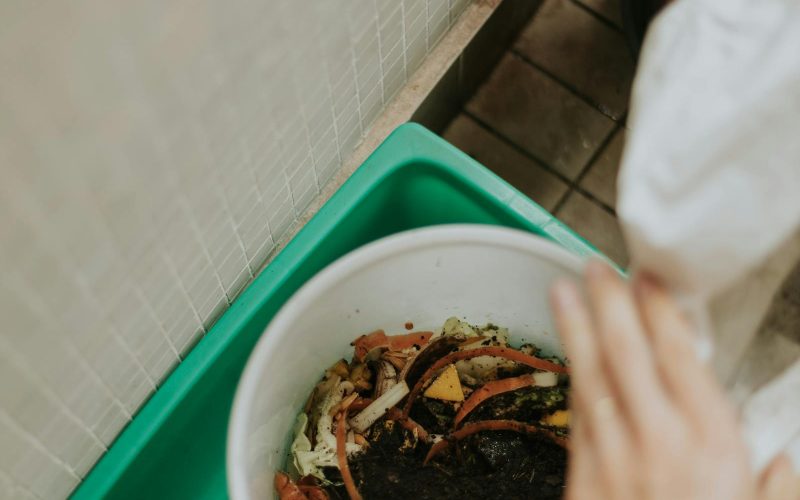
If you want to handle all your scraps yourself but have nowhere for them to finish, bokashi is the bridge. You ferment them in a sealed bucket under the sink (see the dedicated piece on bokashi), then donate the contents, to a community garden, an allotment, a friend with a heap, or your council food waste caddy. Most schemes accept fermented bokashi.
The advantage is that you handle all the food in your flat, with no smell. The disadvantage is the bran costs roughly five pounds a month.
8. Indoor systems that produce something
Worm bins, electric countertop composters, and small in-vessel composters can be run entirely indoors. The output (castings, dehydrated material, or coarse compost) is then small enough to either use on houseplants and balcony pots, or pass on. None of these need any outdoor connection, but they all need you to think about where the finished product goes.
- A small worm bin yields about two litres of castings a month, easily absorbed by even a modest collection of houseplants.
- A countertop dehydrator yields a few hundred grams of dried scraps a week, useful as a soil amendment for a community garden or simply as a stage-one product to take to a drop-off.
- An in-vessel home composter (a sealed insulated unit) produces actual compost in about six months, with little smell.
The realistic combination
Most flat-dwellers I know end up using more than one. A council caddy for cooked food and meat, a small worm bin for peelings, and occasional trips to a community garden when the worms can’t keep up. Or bokashi for daily kitchen waste plus a friend with an allotment who collects it monthly. The shape varies; the principle is that none of the scraps ever go into the rubbish bin.
The “no garden” excuse falls apart faster than people expect when they actually look at what is available within a mile of where they live. I have lived in three different flats in three different cities since I started composting, and I have never needed to put a scrap in landfill. Each time it took about twenty minutes of looking around to find the route. The route is almost always there.
Frequently Asked Questions
Does my council really collect food waste?
Most UK councils do — check your council website or postcode search to confirm. Coverage has expanded significantly in recent years, and from 2026 separate food waste collection is being rolled out as the default across England.
What is ShareWaste and how do I use it?
ShareWaste is a free app and website that maps people willing to take your food scraps for their compost heaps. You search by postcode, contact a host, agree drop-off arrangements. It works best in cities with active gardening communities.
Will community compost schemes really accept random people's food?
The schemes set up explicitly for drop-offs welcome it — they need the input to keep their heaps running. Most have a list of what is and isn't accepted (usually no meat, dairy or cooked food in open community heaps).
Can I really just bury scraps in a planter?
Yes, in moderation. Chopped scraps buried three to four inches deep, covered with two inches of soil, break down in two to three months without smell. Don't overload — a deep window box can absorb maybe a litre of scraps every couple of weeks.
What if my flat has no food waste collection and no community scheme?
Combine bokashi (handles the daily scraps indoors with no smell) with occasional trips to a community garden, allotment, or willing friend. Or run an electric countertop unit to shrink the volume to something easily transported.
Is industrial digestion really better than landfill?
Significantly. Anaerobic digestion captures the methane that food produces and converts it to biogas (which generates electricity), instead of releasing it as a greenhouse gas. The digestate that remains becomes agricultural fertiliser. Landfill is the worst outcome for food waste.