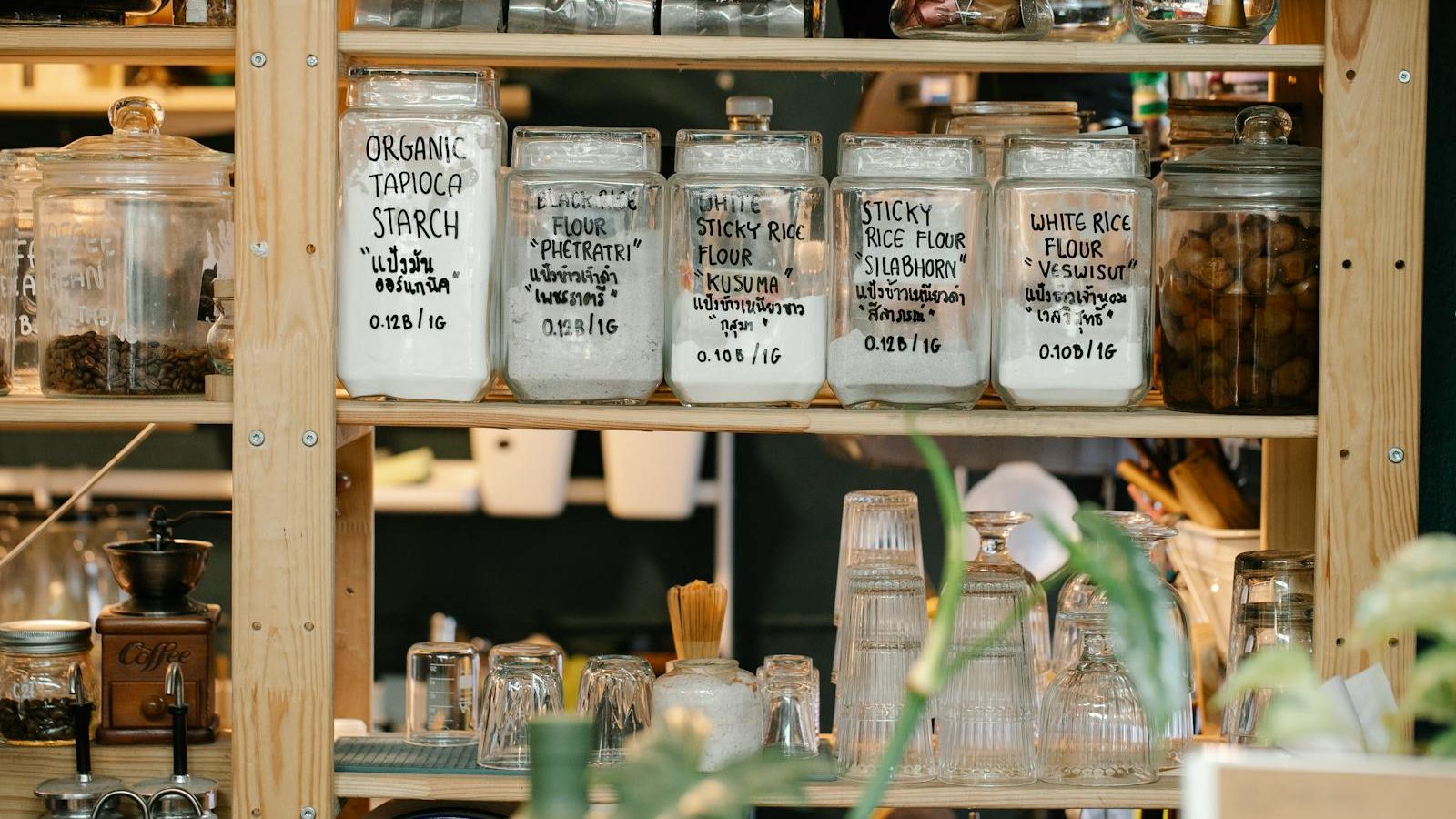
The Pinterest version of a glass-jar pantry has a hundred matching mason jars stacked in three perfect rows, each labelled in elegant brush calligraphy, each containing precisely the right amount of organic something. It looks beautiful. It is also, almost without exception, a fiction.
The real version is more interesting. It is six pasta-sauce jars, four jam jars, two large pickle jars, and a battered olive jar that holds your dried chillies. They do not match. They work brilliantly.
Why mismatched jars are better
Identical jars are visually tidy but practically frustrating. They are usually all the same size, which means tall things stick out and short things rattle around with too much air. A real pantry has a range: small for spices, medium for nuts and pulses, large for flour and rice.
Saved jars come in exactly that range for free. A passata jar is the right size for a kilogram of lentils. A jam jar holds a useful amount of black peppercorns. A large pickle jar happily takes a kilogram of porridge oats. Nothing about this needed to be planned. Repair Café International
Getting the labels off
This is the bit that puts people off. There is one method that works almost always:
- Fill the jar with the hottest water from your tap and put a drop of washing-up liquid in.
- Put the lid loosely on top.
- Submerge the jar in a sink of warm soapy water with the label side down.
- Walk away for an hour.
- Most labels peel off in one piece. Sticky residue rubs off with a scourer or, for the stubborn ones, a smear of vegetable oil.
The exceptions are some jam jar labels glued with industrial adhesive, which sometimes need a second soak or a fingernail scrape. None of it requires solvents.
Lids: the under-discussed problem
The weak point of reused jars is usually the lid. Sauce jar lids smell of sauce forever, even after washing. Some pickle jar lids carry a faint sweet-vinegar perfume that you do not want in your coffee storage.
The fix: separate your lid stash by what they used to hold. Sweet jars (jam, honey) for sweet things. Savoury jars (pickle, mustard) for savoury. Tomato jars get their own pile and end up holding tomato-friendly things, dried beans, lentils, pasta, where a faint tomato smell does no harm.
If a lid is rusty or warped, throw it. The jar usually survives years longer than the lid does.
The five honest uses
1. Dry pantry storage
Pulses, grains, nuts, seeds, dried fruit. Jars keep moths out, which is the single best argument for them. A bag of flour with the top folded over is a buffet sign for pantry moths. The same flour in a sealed jar is invisible to them.
2. Lunch on the go
A salad in a jar, dressing in the bottom, sturdier ingredients in the middle, leaves on top, lasts a full working day without going soggy. The jar washes up in seconds. Office life with a jar of last night’s salad is unexpectedly civilised.
3. Leftovers in the fridge
Pesto, half a tin of tomatoes, leftover soup, the last of a curry. A jar is more honest about how much is left than a tub. You can see at a glance, which means you actually eat it rather than rediscovering it furred over in a week.
4. Freezing stock and sauces
Standard advice says do not freeze in glass. The actual rule is: do not fill the jar above the shoulder. Leave the top third empty for expansion, do not screw the lid on tightly, and freeze upright. Done that way, jars survive years of freezer use. A standard jam jar holds the right amount of stock for one bowl of risotto.
5. Picnic and packed-meal drinks
A jar with a tight lid carries cold tea, lemonade, or wine to a park better than any branded bottle. Cheap, sturdy, washes up properly. The pretence of buying special “mason jar” drinks vessels is unnecessary; you already have them.
What jars are not good for
Honesty matters here. Glass jars are heavier than plastic, which is a real downside if you commute on foot or have a long walk to work. They break, occasionally spectacularly, if you drop them on a tile floor. They are bad for the bathroom cabinet of anyone clumsy with cotton-bud refills.
They also do not make good gift vessels for everything. A jar of homemade chutney looks lovely. A jar of brownies looks like a craft failure. Know the difference.
Letting jars go
The hardest part of keeping jars is letting them go. A pristine glass jar feels too good to throw, so it goes back on the shelf. Then there are forty. Then there is a cupboard problem.
The simplest cure is a rule: jars live on one shelf, in one place. When the shelf is full, no new jars in. This works because the shelf becomes a self-limiting system rather than a hopeful one. The overflow goes into the glass recycling without guilt.
The jars that earn their place are the ones that fit your actual cooking, the rice you eat weekly, the lentils you cook in winter, the spice mix you make in summer. Anything else is decoration, and decoration belongs in shops, not pantries.
The jars that earn their keep on different shelves
Different rooms benefit from different jars. The kitchen takes most of them, but a few well-placed elsewhere can be quietly transformative.
- A jar in the bathroom for cotton buds or hairgrips, replacing the small plastic pots that come with them
- A jar by the front door for keys and the wallet keys, which never seem to have a designated home
- A jar in the shed for screws sorted by size
- A jar on the desk for pens, paperclips, and the elastic bands that arrive on the post
- A jar in the laundry room for stray buttons, hooks, and the small fasteners that come off in the wash
Each of these jars is doing a job that would otherwise have been done by a purpose-bought container costing five to fifteen pounds. The math, over five rooms and a few years, is striking. The aesthetic is mismatched but functional, which is usually a sign of a real, lived-in house.
A quieter approach
Keeping jars is not a hobby and it is not a lifestyle. It is using a free thing that arrives in your house anyway. A small, mismatched, mostly-functional collection of jars is more useful than a curated set, and the only people impressed by matching pantry jars are usually trying to sell you matching pantry jars.
Frequently Asked Questions
Can I freeze in glass jars?
Yes, but leave a third of the jar empty for expansion, do not screw the lid down tightly, and let liquids cool fully before freezing. Standard jam jars handle freezing well.
How do I remove sticky label residue?
Soak the jar in hot soapy water, then rub with a scourer. For stubborn glue, smear a little vegetable oil on, leave for ten minutes, and wipe off.
Are old jars safe for canning and preserving?
Reused commercial jars are fine for jams and chutneys but the lids will not always reseal properly. For long-term preserving, buy proper preserving jars with new lids.
What if a jar smells of its original contents?
Wash with bicarbonate of soda paste, rinse, and air dry in sunlight. Most smells vanish. Persistent ones, particularly garlic, may need a second wash.
Are mason jars worth buying?
Only if you do a lot of preserving. For everyday storage, saved commercial jars work as well and cost nothing.
How many jars is too many?
When you start storing empty jars rather than full ones, you have too many. Fifteen functional, in-use jars is plenty for a household of four.