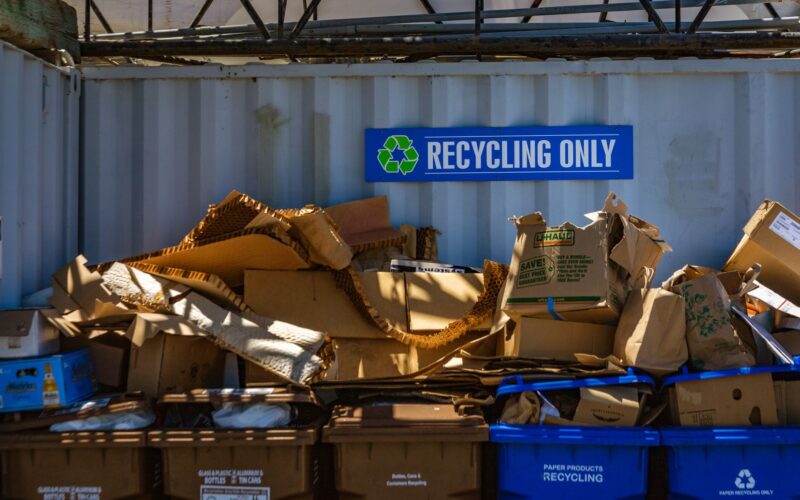

You can tell a lot about a kerbside bin by lifting the lid. Recycling workers can, anyway, they’ve seen everything, and most of them will quietly admit that even households who think they’re doing well make the same handful of mistakes. They’re not exotic mistakes. They’re the kind that come from misreading a label, half-remembering an old rule, or applying common sense in a system that doesn’t always reward it. Almost everyone makes at least one of them.
The good news is that the list is short. If you eliminate seven specific mistakes, your bin becomes more or less perfect. The kit you need is no kit at all, just thirty seconds of attention as items go in. The bigger payoff comes from stopping the wishful items entering the bin in the first place. Each one of these is fixable in less than a minute.
Mistake 1: Bagging recyclables in a bin liner
Many households still tie up their recycling in a black bin liner, the way they would for general waste, and put the whole tied bag in the bin. The reasoning is tidiness. The result is that sorting facilities see a black bag and route it to general waste, on the safe assumption that it’s ordinary rubbish. the EPA’s guidance on recycling contamination Your perfectly clean cardboard travels to landfill or incineration.
The fix: never bag your recycling. Tip items in loose. If you collect them in a bag indoors, empty the bag into the kerbside bin and reuse the bag for the next round.
Mistake 2: Recycling without rinsing
A jar with hummus still in it. A milk bottle with curdled remnants. A peanut butter tub with a centimetre of butter stuck to the bottom. These are all contaminated items, and at scale they can ruin paper bales nearby. The sorting line doesn’t separate food residue from clean material; the material gets sold or rejected together.
The fix: a quick rinse before the bin. No need for soap or hot water, cold and fast does it. For sticky residues, let the jar soak for a few minutes in a sink full of dishwater while you do something else.
Mistake 3: Tiny items
The plastic ring from a milk bottle. The metal cap from a beer bottle. The plastic film from a yogurt pot lid. Anything smaller than a credit card falls through sorting machinery and ends up either lost or in the residue stream. Aluminium foil balled smaller than a tennis ball does the same.
The fix: small items should either be kept attached to the larger item (bottle caps on bottles, lids on jars), nested inside a larger container of the same material, or, where that isn’t possible, put in general waste.
Mistake 4: Black plastic
Black plastic trays and takeaway containers are physically recyclable but practically not, because the optical sorters in most UK facilities use near-infrared light to identify resin types, and they can’t see black. The black absorbs the light. Items pass through invisible.
The fix: until “detectable black” plastics become widespread, treat black plastic as general waste. Some supermarkets have switched to recyclable clear or coloured trays, choose those when you can.
Mistake 5: Soft plastics in kerbside
Carrier bags, bread bags, frozen-veg bags, bubble wrap, crisp packets, plastic wrap. All of them flexible. All of them banned from kerbside recycling in nearly every UK council. They jam the rotating drum sorters and have to be cut out by hand. A single tangled bag can cost a facility an hour of downtime.
The fix: a separate bag at home for soft plastics, taken every few weeks to a supermarket soft plastic bin. Almost every major chain, Tesco, Sainsbury’s, Co-op, Waitrose, now has one.
Mistake 6: Disposable coffee cups
The classic mistake. A paper-looking takeaway coffee cup goes into the recycling bin because, well, it looks like paper. In reality, the inside is laminated with polyethylene to make it waterproof, and standard paper recycling can’t separate the two. A handful of UK facilities have dedicated cup processing, but they’re few, and your council’s line almost certainly isn’t one.
The fix: drop disposable cups in the dedicated bins at Pret, Costa, Starbucks, McDonald’s, and many independent cafes. Or carry a reusable cup, which is the more sustainable answer anyway. Don’t put them in your kerbside paper bin.
Mistake 7: Wishful items “just in case”
The catch-all. Items added to the recycling because the household isn’t sure, but feels guilty putting them in general waste. Crockery, light bulbs, plastic toys, garden hoses, old fabric. All of them clog sorting and contribute to load rejection.
The fix: if you don’t know, look it up or default to general waste. The recycling bin functions as a recycling bin only if it stays one.
A bin-by-bin checklist
If you want a quick weekly habit, glance through your kerbside bin the night before pickup and pull out anything that doesn’t belong. It takes about ninety seconds. The most common offenders to spot:
- Carrier bags (move to soft plastics tote)
- Black trays (move to general waste)
- Coffee cups (save for a cafe with a dedicated bin)
- Tissues and paper towels (general waste or food caddy)
- Anything with food residue (rinse and re-bin)
- Anything bagged tightly (untie and let loose)
A reader’s audit
Tom in Reading wrote in after spending a Sunday morning auditing his family’s recycling for a month. He kept tally. Out of roughly 400 items, 22 turned out to be wrong, soft plastics mostly, plus three coffee cups, a couple of black trays, and a lightbulb that should have gone to the hardware shop. Less than six percent. But, as he put it, “if our four neighbours are doing the same, that’s a hundred wrong items on our street alone, and the lorry only services so many streets.” The arithmetic of contamination is unforgiving.
Why mistakes feel virtuous
Almost every error on this list comes from good intentions. Bagging is tidiness. Tiny items are completeness. Wishful items are optimism. The fix is to replace the impulse with a precise rule, then trust the rule. It takes a few weeks to retrain, and after that the bin starts to look right by reflex.
The kerbside system isn’t fragile, but it’s precise. Treat it like a well-tuned machine and it works. Throw in a wrench and it slows. Once you see your bin through the facility’s eyes, it gets easier to leave things out that don’t belong.
Frequently Asked Questions
Why is bagging recyclables a problem?
Black bags are routed to general waste by default at most sorting facilities. Even if the contents are clean, the bag won't be opened. Always tip items loose into the kerbside bin.
How clean is "clean enough"?
A quick cold rinse to remove visible food residue is plenty. You don't need to scrub. The aim is no spillage, no leftover food, no stickiness — not a sterile finish.
What is "detectable black" plastic?
It's a new generation of black plastic that uses a pigment visible to infrared sorters. Some supermarkets are switching to it, but most black plastic still in circulation can't be sorted.
Should I leave the cap on a plastic bottle?
Yes, modern facilities prefer caps left on. They keep small items together rather than letting them get lost in sorting machinery.
Can I recycle a coffee cup at all?
Yes, but only through dedicated schemes at major cafe chains. The kerbside paper stream isn't able to separate the plastic lining from the paper.
What happens if I make a mistake?
One mistake is fine — the facility will pull it out. Many mistakes from many households, however, push contamination above the threshold where the load gets rejected. Aim for accuracy, not perfection.