
Open any home-office drawer in any flat in Britain and you will find at least seventeen pens. About half of them work. Three of them have lids missing. One is so old it has fossilised into half-dried biro. The remaining seven are functional, which is roughly seven more than anyone needs at one time.
Office supplies accumulate quietly. They are small, they are sold cheaply in multi-packs, and they sit at the back of drawers for years. Most of the reuse advice is about getting out of the cycle of buying them in the first place, then using what you have until it is genuinely finished.
Pens, pencils, and the great inventory check
The first step in any office supplies reset is a pen audit. iFixit News on repair culture Empty the drawer, test every pen on a piece of scrap paper, and sort:
- Working pens (keep)
- Pens that work after a minute of scribbling (keep)
- Pens that genuinely do not write (recycle through a specific pen-recycling scheme if possible, or general waste if not)
- Pens that are nearly empty (move to the front of the drawer to use up)
Most households end up keeping six to ten pens after a proper audit, down from twenty or thirty. The smaller number is somehow more useful. You can find one when you want one.
Pen recycling schemes do exist. TerraCycle runs a free pen, marker, and stationery recycling programme in partnership with various retailers. Repair Café International Drop-off points are listed on their site. The plastic gets shredded and reused.
Pencils
Wooden pencils last for years and are easy to reuse. The stubby pencils that get too short for adult fingers are perfect for children and travel notebooks. A pencil sharpener pays for itself many times over compared to disposable mechanical pencils.
Paper and notebooks
The biggest stationery category and the easiest to reuse.
Half-used notebooks
Almost every household has at least three half-used notebooks. Combine them. Tear out the few used pages from one, transfer any active notes to another, and the freed notebook becomes a new blank one. A reader, Aisha in Liverpool, told us she has not bought a notebook in eight years. She runs through old half-used ones, then moves on to old diaries from the back of a drawer.
Loose paper
One-side-used paper from forgotten print jobs, school worksheets, or old letters is the most useful free resource in any home office. A stack of A4 with one blank side becomes:
- Scrap paper for shopping lists and rough notes
- Drawing paper for children
- Wrapping paper for small parcels
- Folded into makeshift envelopes for paying tradespeople in cash
- Filing for non-permanent notes
The simplest system: a stack on the desk, blank side up, with a paperweight or clip. When the stack runs low, refill from the recycling pile. It never costs anything.
Envelopes
The envelopes from junk mail are reusable for internal household paperwork, paying the milkman, returning forms to school, organising bills. Cross out the old address, put a new label or simply write over, and they do another job.
For sending external post that needs to look professional, plain new envelopes are still worth the small cost. The reuse approach is for internal and informal uses.
Folders, binders, and dividers
Among the most over-bought and under-used office items. The reuse routes:
- Empty folders from finished projects can be relabelled and reused
- Lever-arch files last for years; the mechanism rarely fails
- Plastic wallets and document pockets are reusable if you peel off old labels with the soaked-jar method
- Folders that are no longer needed go to schools, charity offices, or Buy Nothing groups
Plastic ring binders are the longest-lived office item. A good one bought fifteen years ago is still working. Charity shops always have boxes of them at fifty pence each. Buying new is rarely necessary.
Sticky notes and the small irritations
Sticky notes are the small luxury that quietly costs the most. A pack of branded sticky notes is around three pounds and contains around 400 squares. Each one is used once for a few hours, then binned.
The honest alternatives:
- A small reusable notebook for to-do lists, replacing the temporary nature of sticky notes
- Whiteboard or chalkboard for ephemeral reminders
- Cut-up scrap paper held with a paperclip or magnet
- Phone notes for things that genuinely do not need a paper version
If you genuinely love sticky notes for their convenience, there are now reusable, wipeable ones that last for hundreds of uses. About six pounds for a pack that replaces a couple of years of standard sticky notes.
Paperclips, drawing pins, rubber bands
These small fasteners last decades if not lost. The reuse routes are obvious: keep a small jar of each, top up only when you run out. Most households have far more of these than they need.
Excess paperclips and pins can go to schools, where they always need more. Wedding stationery, scrapbooking, and craft supplies often consume them as well.
Printer cartridges
The most environmentally significant office category. New cartridges are expensive and produce substantial plastic waste. The honest options:
- Refilling cartridges through specialist services (around half the cost of new)
- Buying compatible cartridges from third parties
- Refilling ink yourself with a kit (cheapest but messy)
- Switching to a refillable-tank printer for the long term
Used cartridges, regardless of how they were originally bought, can be returned to most office stores or supermarkets for recycling. Some charities collect them as a fundraiser.
The drawer organisation question
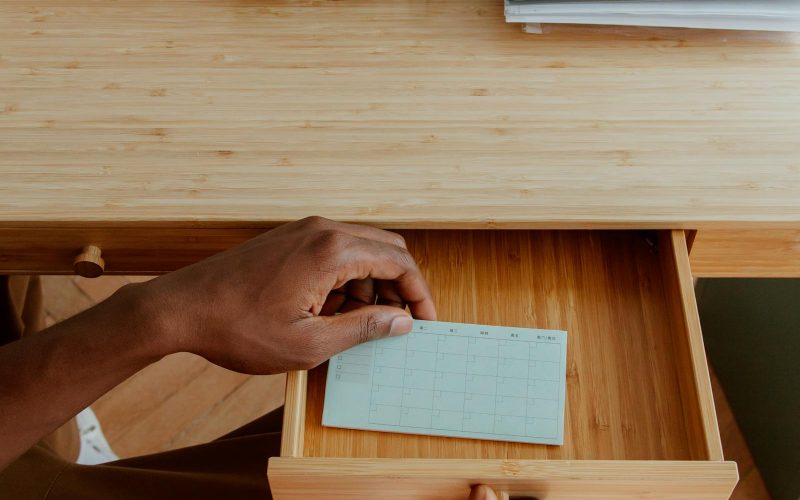
A drawer of randomly mixed stationery becomes a drawer of unfindable stationery. A few simple compartments, small cardboard boxes from shoeboxes, the inside of biscuit tins, the bottom of yoghurt tubs, turn it into a working system. Pens together, paperclips together, scissors here, sticky notes there. No money spent.
The principle is the same as the kitchen drawer: small containers contain. Without them, every drawer becomes the same kind of chaos.
What office reuse really does
The reason any of this matters is not the individual saving on each item. A single pen reused is worth nothing. The reason is the change in pattern. A household that uses what it has, finishes what it starts, and refills only when needed shifts away from the small constant trickle of “stationery shopping” that quietly costs forty to a hundred pounds a year and produces a steady stream of plastic packaging.
The same shift extends to the workplace. Once you stop bringing new pens home, the office cupboard stops emptying as fast. The colleague who once asked for a new highlighter every fortnight gradually stops asking. The collective effect is small per person and substantial across a building.
Stationery is not the bit of household reuse that makes good headlines. Nobody writes a magazine feature about reusing paperclips. But it is the bit where a single pen-audit Saturday produces an immediate, visible result, a drawer that closes, a desk that works, a steady reduction in what gets bought. The reward is disproportionate to the time spent.
Frequently Asked Questions
Where can I recycle pens that no longer work?
TerraCycle runs a free pen recycling scheme via drop-off points in some retailers. Otherwise, pens are not recyclable in standard kerbside collections.
Can I reuse plastic wallets that already have labels on them?
Yes. Soak the wallet in warm soapy water for an hour, peel off the label, and dry. Stubborn glue rubs off with a little oil.
Are refilled printer cartridges as good as new ones?
Usually yes, particularly for everyday text printing. Photo printing can be slightly less consistent. Independent refill shops are often better than the brand stores.
How long do lever-arch files last?
A good quality lever-arch file can last decades. The mechanism is usually the last part to fail, and replacements can sometimes be found.
What do I do with old academic notes and folders?
Recycle the paper, keep useful folders for new projects, and pass plastic wallets to friends or community groups. Old folders with binding still intact are welcome at schools.
Are sticky notes really wasteful?
Per individual note, no. Across an average office worker's career, they add up to a meaningful amount of paper and adhesive. A small notebook or whiteboard does the same job with far less waste.